Fool's Gold
By Kulito
Editorial/Column: Kuro-Kulito October 19, 2026
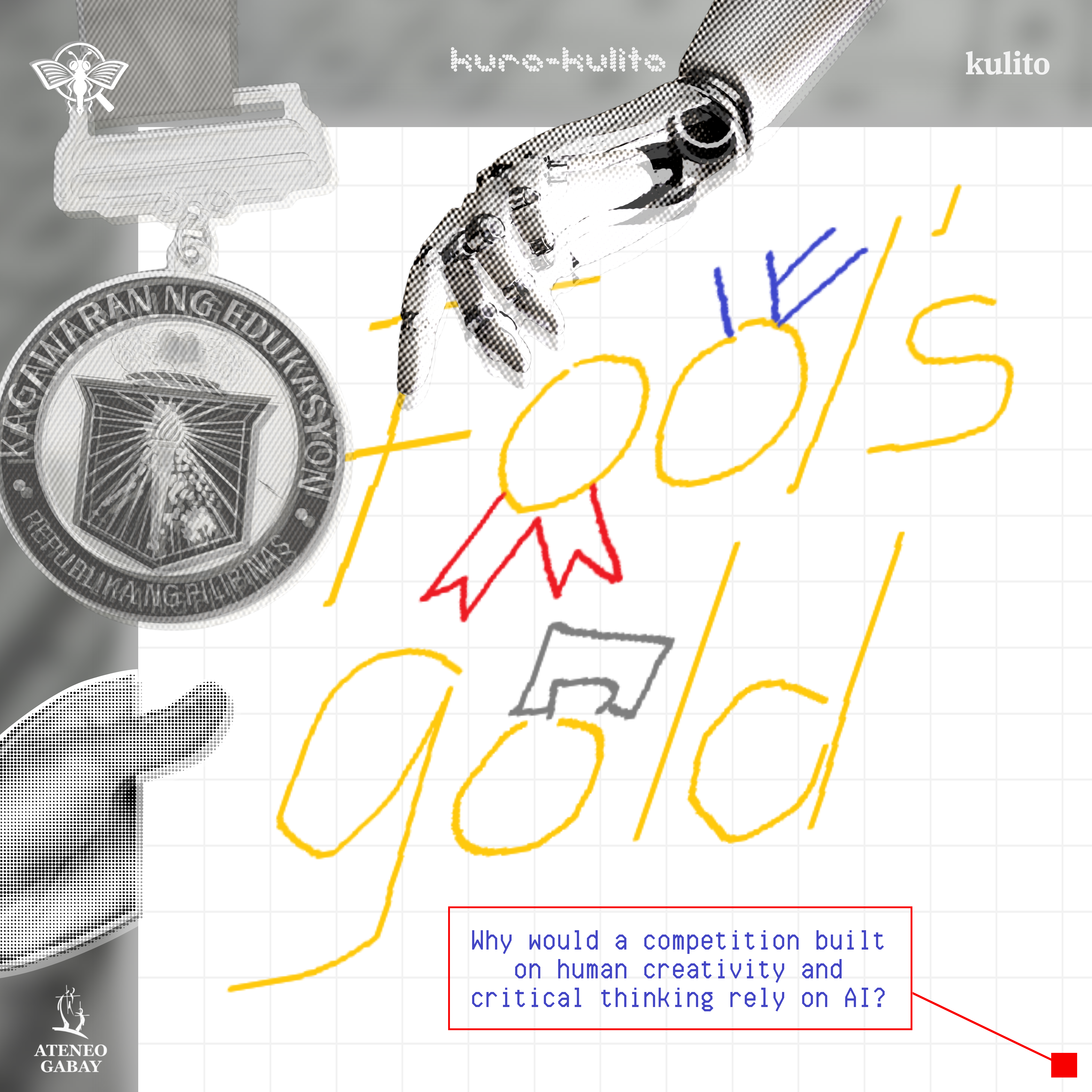
Why would a competition built on human creativity and critical thinking rely on AI?
For an annual event created to champion human talent and creativity, the awards handed out at one of this year's most anticipated journalism competitions delivered a glaring irony. On the 17th of September 2026, Facebook user Rick Maquiling posted photos of the awards for the Division Schools Press Conference (DSPC) 2026 of Iligan City in Mindanao, which sparked outrage as the graphics embedded in the awards looked as if they were AI-generated. The post garnered an estimated 10,000 reactions and 4,000 shares—with the comments expressing anger and disappointment at the alleged use of AI. After all, the DSPC and other such journalistic competitions were established under Section 8 of Republic Act (R.A.) 7079, also known as the Campus Journalism Act of 1991. The law exists to enable the freedom of the press at the campus level and to strengthen ethical values, encourage critical and creative thinking, and develop moral character for the Filipino youth. The DSPC is built on discipline, integrity, and each journalist's pursuit of truth. Participation in the DSPC is the culmination of weeks of preparation, yet the Department of Education (DepEd) decided to award these inspired journalists with uninspired art, lazily replicated by AI.
Inside a confined classroom, a student journalist stares at a ticking clock. For four long, exhausting hours, they are strictly forbidden to ask for outside assistance or consult with search engines—most especially artificial intelligence (AI), which entered the mainstream a few years ago. In this space, they are bound by strict rules implemented by the Department of Education (DepEd) that threaten them with disqualification once a single sentence from their output mimics even an ounce of someone else’s work. In an adjacent classroom, an editorial cartoonist is bound by the same level of guidelines. The ink gets smudged on their fingertips, but each stroke they produce carries meaning and encapsulates their hard work—transforming ideas into a single coherent piece that expresses truth.
This is the reality of the yearly Division Schools Press Conference (DSPC). In assessing their works, there is a heavy expectation that the competition will highlight the individual skills and ingenuity of students. However, when the winners of this year’s DSPC in Iligan City in Mindanao were finally called on stage to recognize their hard work and talent, the foundation on which the DSPC was built upon collapsed. Instead of awarding them with creative human-designed medals and trophies to celebrate their craft, DepEd handed them awards that feature AI-generated graphics. This is a complete slap in the face to the students who do their utmost to prepare for the competition—exerting their time and energy into training, seminars, and mental preparation. In this competition designed to encourage human creativity and critical thinking, the awards showed no trace of such.
Under the nationwide banner of DSPC 2026, “Empowering Filipino Youth: Unleashing Potentials in Journalism and Creative Industries in the Era of Artificial Intelligence,” the incident in Iligan City sparked several social media posts illuminating the issue of widespread AI use and the toxic double standard within the education sector. Students are trained to uphold strict rules and guidelines, while administrators who train them take the easy route—resorting to lazy and uninspired work—to reward them for their adherence. It presents a question: “How can an institution demand uncompromising integrity from its campus journalists when the tools it uses are so far removed from the values that it is built on?”
In an ever-changing world, proponents of integrating AI into media and education argue that schools must now keep pace with the current technological advances. In newsrooms, generative tools are used due to their speed, their ability to streamline and organize data, and their utility to automate and follow deadlines. From this perspective, teaching students to utilize AI prepares them for an automated world, which supposedly makes this technology beneficial for young writers by making grammar checks easier, suggesting words, or doing outlines.
However, that argument completely ignores how flawed the technology is at its core. We live in a world of post-truths. O’Callaghan (2019) defines the post-truth world as one where objective facts have lost currency and people are more willing to believe in emotional appeals. As we go further into the digital age and push the limits of technology, it becomes increasingly simple for those in power to control the information that we have access to. As a person scrolls through social media and e-commerce platforms, every post and product that they see is a result of an algorithm studied and produced by AI, which, in turn, is controlled by global technology companies—think Elon Musk, Mark Zuckerberg, and the like. What we see is controlled by people who have an agenda, and it becomes so easy to push ideologies and narratives into people’s heads when it is frequently reinforced and shown by algorithms in echo chambers. This, fundamentally, compromises critical thinking because it purposefully misleads and hides information that we have a right to access.
As an emerging issue, campus journalists should be aware of the dangers of AI and what it means for our society. In and of itself, the theme has this notion of overcoming the era of artificial intelligence and continuing to highlight the potential of journalists and people in creative industries, but the AI-generated awards go completely against this idea. Instead of honoring Filipino artists who could have been commissioned to create art which symbolizes human creativity persevering in an era that prioritizes efficiency over heart, the awards are made using the very thing that campus journalists must overcome. It sends a message that their labor of love amounts to a single prompt and graphics generated in at most, a minute.
Responsible journalism is grounded on truth-telling and an unbiased lens. With the advent of AI, many reactions and narratives have been put forward by various groups. Campus journalists can and should be knowledgeable about the different sides of each argument—weighing the pros and cons and ensuring that balanced news reaches their audience. However, the AI theme of the competition is not an excuse to give out awards which contain no trace of original human creativity because AI can only imitate. Its sources for deep learning—especially for generative content—are dubiously ethical. Kosinski (2026) states that there is a lack of transparency with how AI processes data and where exactly the data comes from. Many artists have had their art stolen and processed by AI without their consent in an effort to recreate their art style. According to Crabapple (2026), AI not only steals the artwork of creatives but takes their jobs along with it. Thus, it is incredibly hypocritical of an event whose purpose is to “strengthen ethical values” and “develop moral character” to utilize tools that are morally questionable.
If DepEd genuinely intends to guide the youth through this technological era, it must first practice the values it preaches. Moving forward, the education department should implement clear AI guidelines across its divisions. AI may only serve as a tool for data organization and not a total replacement for writing, reporting, and creating art. More importantly, DepEd must mandate that all contest collaterals, medals, trophies, or certificates be commissioned directly from students or local Filipino artists to ensure that the resources meant to celebrate human authenticity support actual people, thereby financially and morally uplifting the beating hearts behind our local creative industry, instead of relying on a free. but lifeless machine.
The heart of journalism is not the outputs produced—it is relationship-building, accountability, and the human judgment required to bear witness and connect the public to current events. AI only severs that connection. As DepEd pushes it as this year’s flagship DSPC theme, championing "empowerment" and "unleashing potentials," its own organizers undermine that message by handing out AI-generated awards to students who gave their blood, sweat, and tears under strict rules. The campus journalists may have unleashed their potential, but one cannot say that DepEd has also unleashed theirs. AI cannot be sued, cannot be held accountable, and most importantly, cannot replace original thoughts. AI art is thoughtless—a cheap imitation of human creativity. Paradoxically, DepEd threatens to suppress, rather than unleash the very creativity it claims to champion. If institutions demand uncompromising integrity and grit from campus journalists, they must hold themselves to the same standard. Because after all, every award and every accolade that is devoid of authentic human effort can never genuinely honor the relentless human spirit required to earn it.
BibliographyBangayan, Harvey, and Gadjel Herodias. “PIA Empowers Campus Journalists to Use AI Tool Responsibly.” Philippine Information Agency, 15 Apr. 2026, pia.gov.ph/news/pia-empowers-campus-journalists-to-use-ai-tool-responsibly.
Center for News, Technology & Innovation. “Artificial Intelligence in Journalism.” Center for News, Technology & Innovation, 17 Sept. 2026, cnti.org/issue-primers/artificial-intelligence-in-journalism.
Crabapple, Molly. “Is AI the Greatest Art Heist in History?” The Guardian, 14 May 2026, www.theguardian.com/books/2026/apr/12/is-ai-the-greatest-art-heist-in-history.
Dalan, John Den Saul, and Rey Enciso. “Exploring the Impact of Artificial Intelligence on Campus Journalism A Literature Review.” Institutional Multidisciplinary Research and Development Journal, Jan. 2024, https\://doi.org/10.13140/rg.2.2.24781.61926.
Habib, Sabrina. “AI Can Help ? and Hurt ? Student Creativity.” University of South Carolina, sc.edu/uofsc/posts/2024/02/conversation-ai-help.php.
Kosinski, Matthew. What Is Black Box AI? 19 Mar. 2026, www.ibm.com/think/topics/black-box-ai.
Maquiling, Rick. Photos of AI-generated awards for the Division Schools Press Conference in Iligan City. Facebook. 17 September 2026. https\://www.facebook.com/share/19fcFyXofK/
O’Callaghan, Cian. “Postpolitics and Post-Truth.” Elsevier eBooks, Dec. 2019, pp. 339–45. https\://doi.org/10.1016/b978-0-08-102295-5.10683-3.
Philippine Congress. “Republic Act NO. 7079, July 05, 1991, https\://elibrary.judiciary.gov.ph/thebookshelf/showdocs/2/2685
Shin, Jieun. “AI and Misinformation.” University of Florida College of Journalism and Communications, 2024, 2024.jou.ufl.edu/page/ai-and-misinformation.
United Nations. “Artificial Intelligence and the Future of Journalism: Risks and Opportunities.” United Nations Western Europe, 10 Nov. 2025, unric.org/en/artificial-intelligence-and-the-future-of-journalism-risks-and-opportunities.