Headless Monsters Tell no Tales
By Daniel Gil Eclevia
Kuwentong Kulito October 30, 2026
When I was young, monsters didn’t scare me; failure did. As I entered university, it came back to haunt me.
Growing up, I never really believed in spirits or ghosts. In fact, I was raised in what some may call a “boring” household, which taught me to question everything that I hear or see, whether that be a social media post claiming that magic was real or my grandparents telling me that I need to be a good person so that I wouldn’t be punished. Perhaps my Tatay’s story will convince you that monsters aren’t real. For me it surely did, or at least it used to. I trace my skepticism back to the first horror story I have ever heard as a kid.
The Story of the Headless Monster
“Narinig mo na ba ang kuwento ng pugot-ulo?”
Hearing those words from my Tatay was quite surprising. After several years of me just watching television programs like Bill Nye the Science Guy and National Geographic, this was a sudden change of pace for me. I think it was the atmosphere that called for such a story. It was typhoon season in the Philippines. It was quite gloomy outside, and the strong winds howled against the trees. The lights in our house flickered, so my mother decided that we should just turn them off. It was dark and cold, and I was huddled in a blanket—the perfect start to any horror story.
“Hindi po,” I answered him. “Lumapit ka dito,” he replied.
He then went into excruciating detail describing the traits of this monster. Its skin was a sickeningly translucent white with veins that protrude out like the roots of an old tree. Its arm-length fingernails were yellowed, crooked, and jagged. And most frighteningly, how it prowled through the midnight silence on all fours, sniffing out the quiet whimpers of disobedient children to drag into the darkness and devour. My blood ran cold, but I wanted to know more.
“Paano siya kumakain ng bata?”
I was worried. I recalled all the “bad” things that I did in the past few weeks. Did I stay up too late when I should be sleeping? Did I eat too much junk food? Maybe he was telling me this story because I threw a temper tantrum that one time I wasn’t given a toy at the supermarket. If that’s the case, then I was guilty as charged. As I start to think about my impending fate, he tells me:
“It can’t, it died a day later.”
“Bakit?” I asked him.
“Wala siyang mata, hindi niya mahanap ang mga bata.”
“Meron ba siyang bibig?” I responded.
“Wala rin, wala ngang ulo diba? It died of starvation.”
…Was that it? My first horror story ended abruptly, and honestly, anticlimactically. However, it was absolutely hilarious to my Tatay and I. I was relieved that this monster wasn’t real—it was headless after all. This wasn’t really a horror story. I guess it was his dry sense of humor. Something that I inherited from him. Even though it wasn’t that funny, my sides began to hurt.
Looking back at the story now, it had a lesson that manifested itself implicitly throughout my life. For starters, I no longer believed in monsters. Needless to say, I was the killjoy during my elementary years, sarcastically remarking to my friends, “Payag ka ba, manananggal ka, pero lengthwise?”
But it also manifested itself in my perception of reality. When I see or hear something that I think is absurd, I would always dismiss it as if it wasn’t a problem or that it did not exist. It also changed my approach in life. Whenever I was faced with a problem, the lessons and stories of my Tatay reminded me that before being driven by emotions like anger or fear, I needed to take a step back and see the bigger picture. Of course the monster couldn’t eat me; it had no head!
And finally, it manifested in my academics. Back in elementary up until high school, I would always ask questions until the topic made sense to me. If that didn’t work, I would study on my own to “solve” those questions. That is why I used to love science, as I was curious and wanted to understand the things around me.
I couldn’t be easily satisfied with the ‘sabi-sabi’ of other people. I needed evidence or at least a rational explanation for me to be convinced. The concept of gravity has a way of explaining things that no supernatural event can—let alone a superstition. For as long as I didn’t understand, I would keep investigating to form my own conclusions.
Yet, with this persistence also came the pressure. What if I couldn’t disprove the superstition? What if, after all the studying that I did, I still couldn’t find the answer to my question? What if there was an exam and I still didn't understand the basics and was trailing behind on my lessons? Worst-case scenario: what if I failed?
An exam wasn’t something that you could simply disregard like a monster. It is real. It is a measurement of your understanding. And it is something that can make or break your grades—a measurement of your value as a student.
Back in high school, I did pretty well in my academics. I never had to worry about my grades or my exam scores. I thought it came naturally to me. This performance eventually landed me a scholarship at the Ateneo de Manila University, a school I never even imagined I would pass, let alone attend.
Starting my first year of college, I was confident that I would do well, be responsible with my time, and maintain my scholarship. I was nervous, yes, but nothing prepared me for the horror I would experience in my first semester.
Blood on the First Page
No matter how hard I tried, I struggled to understand the topics that my first-semester courses threw at me. I remember my first calculus exam where I studied for several days straight. I was scratching and ripping out pages of my yellow pad just to solve one problem. I watched several YouTube playlists and even went through two pen refills. I probably bit my nails till they were soft. I was that anxious.
Then came exam day. I don’t usually believe in superstitions or sayings. Even when I took the USTET, I didn’t follow my friend's advice, which is to break my pencil for good luck before I entered the exam room, because it didn’t make any sense to me. However, this time was different. As I prepared my breakfast, I avoided my usual eggs with pancit canton. I was afraid I might get a zero. As I went through my closet, I made sure to wear my “lucky clothes” hoping that I would get good karma.
When I finally went to the exam room and fiddled with my calculator and pen, our professor grabbed his thick pile of exam papers and started distributing them throughout the classroom. As soon as I received my test paper, my mind went completely blank.
I was taken aback by fear. I knew what was on the test paper. I have studied, rationalized, simplified, and hell, even square-rooted everything that was on it, and yet, I couldn’t recall a single thing that I learned. My pen was still, but my heart was racing. I had to do something, so I wrote whatever I could remember, albeit limited. As the timer displayed on the projector went to zero and our professor called for us to pass our papers, I knew, and I did, indeed fail.
The first page of my exam paper was marked in all red ink as if a kid had scribbled all over it. Even questions I thought I did right had minor errors, which further deducted my score. The exam was unforgiving, and so too was my professor. Immediately after I saw my score on the top right of the page, I tucked it in my bag. I thought hiding the monster would save me from the consequences, but it didn’t work. The fear of failure consumed me.
I was completely demoralized. This piled on top of my other course requirements, and from then on, I was off my balance. Whenever my teachers announced that we were going to have a pen and paper exam, no matter what the subject was—even if it wasn’t math—I was struck with dread. It became my very own monster—a thing I truly feared.
It didn’t help that they went into harrowing detail describing the exam types. Modified true or false… essays… identification… enumeration… problem-solving… and many more. With each exam I struggled in, the more I started to lose my confidence and the more I was afraid of failing.
When the semester ended around December and they started releasing the grades on AISIS, my Christmas present was an unsatisfactory grade in calculus. Thankfully, it was just a bridging program, so it didn’t affect my QPI nor my scholarship status in Ateneo. Nevertheless, this served as an alarming revelation for me. If I continue with this kind of performance in the next semester, I will most likely lose my scholarship. As I prepared for my greatest challenge yet—calculus proper—I knew something had to change.
Facing My Headless Monster
When I tucked my first calculus exam paper in my bag, it was the last time I ever looked upon it. I just wanted to forget, but I couldn’t. I had to face my fear. I had to look back, and what I saw surprised me. Many of my mistakes came from the process of solving the problems. At some points, I was on the right track but suddenly diverted from it, and at others, I had the right solution and answer but decided to scrap it because I thought it was wrong.
When I reflected on the day of the exam, I realized that I didn’t have the confidence nor the trust in myself despite studying for several days and being able to solve the practice problems with ease. There was always this lingering doubt that even though I had prepared, the rug would be pulled from under me. I felt the same way in high school but never to the extent I did in university. When I was younger, I was convinced that I would fail every math test I took, only to be pleasantly surprised when I walked away with great results time and time again.
I had this preconceived notion that I was indeed terrible at math. I never really questioned where I got this idea from. I told myself that it was just the way things were. This was quite ironic knowing that I’ve been raised to be skeptical of the things around me. Unfortunately, this didn’t extend to the things I believed about myself. This experience took me back to when I was a kid, sitting right next to my grandparents. When I asked them questions, the response was usually, "Gano'n lang talaga!”
As I grew older, I became more interested in the social sciences, which amplified this thought of mine. On social media and in friend group gatherings, I fell into the stereotype that I was more of a writer than a math wizard. As time went on, I wholly accepted that identity and slowly lost the interest I gained from watching those television programs when I was a kid.
So when I started my journey here in the Ateneo, I had no choice but to break free from that label that I wholeheartedly accepted. I reflected on how I previously reviewed for my exams, and I figured that I’ve been studying like I was already doomed to fail. It pulled me back to when I was a kid, thinking that I was naughty. I treated my academics as something that was life or death—which quite honestly was absurd. Hence, when I faced the exam, I was practically letting it consume me. My value as a person became solely dependent on my scores.
But that wasn’t the case. No matter how poorly I did on the exam, I was still alive; beaten, sure, but not dead. There was always another exam for me to improve on. What I initially thought was my requirements stacking up were actually more opportunities for me to recover. While all of this may sound like I’m trying to win the gold medal in mental gymnastics, it really helped me reframe my past failures as something that I can learn from.
Come second semester, I decided to take a different approach when it came to studying. Instead of tackling a problem head-on, I had to take a step back and recuperate. When I reviewed the "monster," I broke it down by parts, mastered the basics, and looked at the bigger picture.
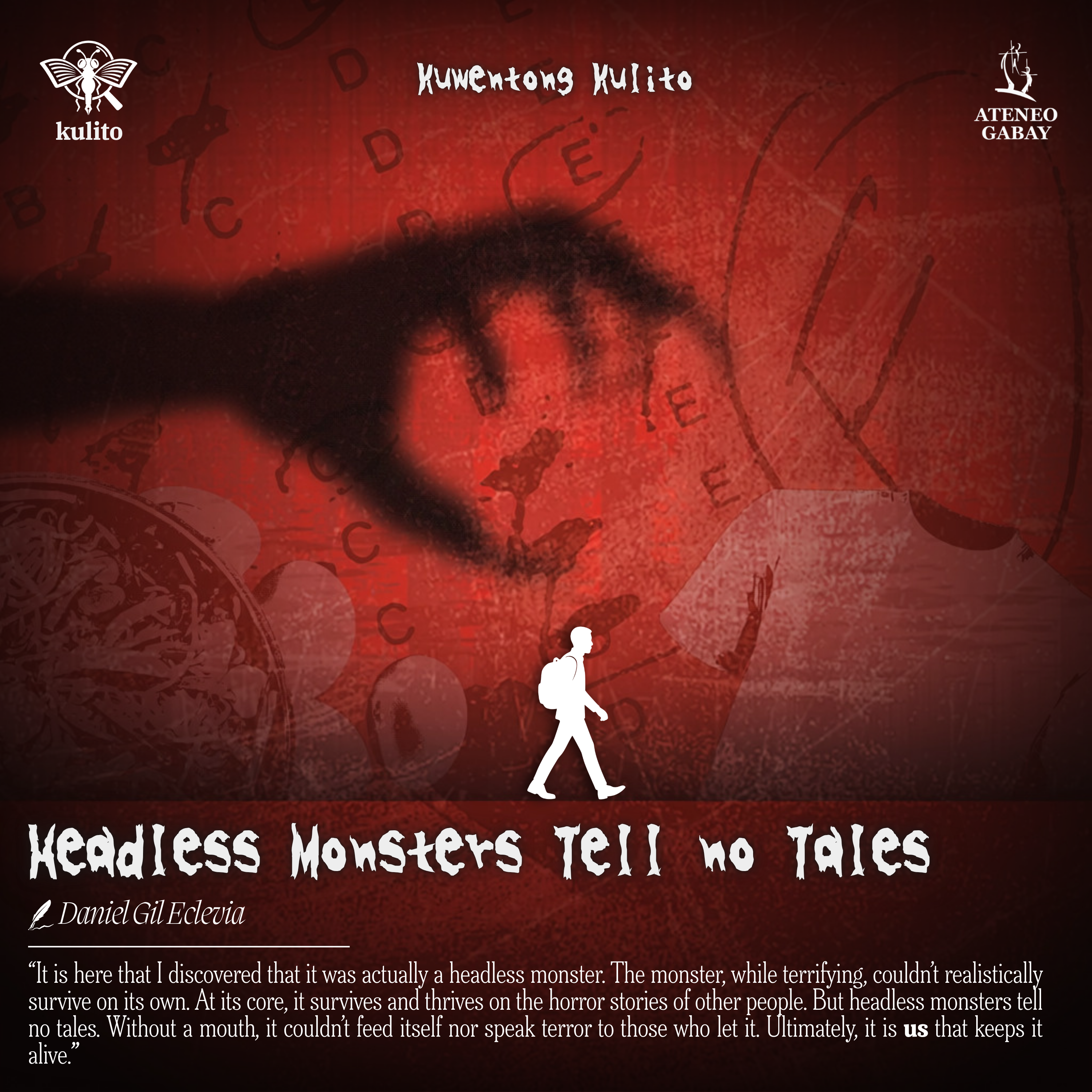
It is here that I discovered that it was actually a headless monster. The monster, while terrifying, couldn’t realistically survive on its own. At its core, it survives and thrives on the horror stories of other people. But headless monsters tell no tales. Without a mouth, it couldn’t feed itself nor speak terror to those who let it. Ultimately, it is us that keeps it alive.
The subject wasn’t really difficult; it was just doubt creeping in and manifesting itself in my lack of confidence and scores. Calculus became clearer to me. I didn’t have to study like my life depended on it; rather, I studied systematically, understanding it and rationalizing it until I could explain it simply and independently. It was the quality of the review, not the quantity.
The second semester treated me more kindly, or rather, I treated myself better. Feeding the monster that is self-doubt and fear wasn’t going to help me in the long run. I had to let go of the idea that I was naughty and incapable of understanding what was thrown at me. The monster must not have a hold on me. Though I still avoid eggs and wear my “lucky” clothes before an exam, I regained more confidence in myself rather than relying on superstitions and brute review sessions. I turned what was an unsatisfactory performance in the first semester into something I was proud of in the second.
I’m still haunted by the ghosts of my failures, but there’s a reason why we visit tombstones and pay our respects to the dead. They are what make us—what shapes our character. What I once saw as failures were actually lessons in disguise. My past stumbles were never dead ends, just steep learning curves. I would be lying if I said that the future exams no longer terrify me, but if there is something that I’m sure of, it’s that I will take a step back, examine its parts, and look at the bigger picture. There is no bravery without fear, and I will not feed my doubts in my head.
After all, what is a headless monster but the manifestation of one’s imagination, fear, and doubt?