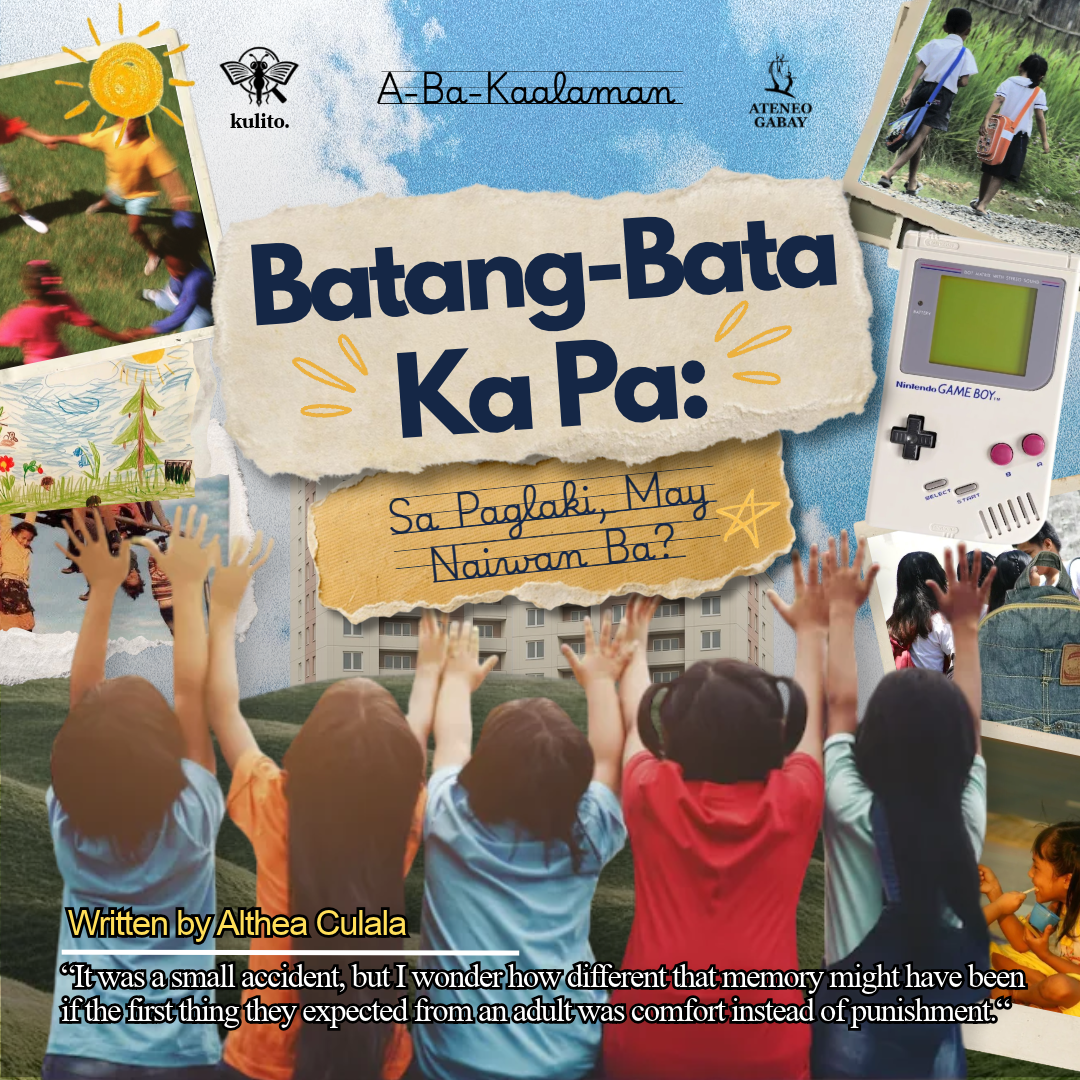
Batang-bata Ka Pa: Sa Paglaki, May Naiwan Ba?
By Althea Culala
A-Ba-Kaalaman November 5, 2026
Batang-bata ako, nalalaman ko 'to
Inaamin ko rin na kulang ang aking nalalaman
Ngunit kahit gan'yan ang kinalalagyan
Alam ko na may karapatan ang bawat nilalang
Kahit bata pa man, kahit bata pa man
“Batang-Bata Ka Pa,” the song by Apo Hiking Society that lends this piece its title, reminds young people that there is still much they have yet to learn. But being young does not make their rights any less important.
It is an easy point to agree with. It is harder to say whether we ever felt it.
A child falls into a koi pond.
The water smells like rotten eggs. Their clothes are soaked. But before they can even think about the fall, they are already worrying about how to tell their mother. They know they will get scolded.
That child was me. I remember this as one of my childhood mishaps. Not because of the fall itself, but because of the dread that came after. Mom eventually found out, and I got in trouble for my own carelessness.
It is a small memory, one that might seem ordinary enough to laugh about years later. But looking back, I wonder why I remember being afraid to tell my mother about a small accident more vividly than the fall itself.
When we think about childhood, we usually reach for the lighter things first: the games we played, the places we went, and the people we spent our afternoons with. For Yani, it was the ride home from school in their family’s 1989 Nissan Vanette, with the setting sun turning the sky a vibrant orange. They looked forward to playing Counter-Strike after class, even when their father teased them about being “allegedly” addicted to the game.
For Lei, it was Minecraft. Without access to the official game at first, Lei’s parents got a cracked disc that allowed them to install it on their laptop. Eventually, when the family got the official game on a PlayStation 4, Lei and a younger sister would spend hours building in a creative, flat world. The room filled with their voices as they exchanged ideas.
Rio remembers a family meal at a beachfront restaurant in Alinao, San Juan, Mabini, Batangas. There was seafood on the table, the cool breeze from the sea, and the sound of waves in the background.
These are the kinds of memories we often associate with growing up. But when I asked my interviewees to look back, our conversations eventually moved beyond what we remembered fondly. They turned to what we were allowed to do, what we were taught to believe, and what we learned not to say.
But what happens to the things we were never allowed to say?
November is National Children’s Month, established through Republic Act No. 10661, or the National Children’s Month Act of 2015. The observance commemorates the adoption of the United Nations Convention on the Rights of the Child (UNCRC) by the United Nations General Assembly on November 20, 1989. The Convention recognizes children's rights to express their views and be heard (Article 12), to protection from violence (Article 19), and to rest, leisure, and play (Article 31).
These rights can sound straightforward when discussed in classrooms or written on posters, but knowing that children have rights is not necessarily the same as growing up feeling that those rights are yours to exercise.
I wanted to understand that difference. Instead of simply asking whether my interviewees knew their rights, I asked whether they remembered feeling them.
The right to play
My childhood had plenty of afternoons spent outside with friends. We played patintero and langit-lupa, and it was only when the pandemic hit that screens began to take over those afternoons.
For Lei, toys were a constant presence growing up. Their parents were not particularly strict, so Lei could wander around with a toy in hand, often drawing other people into whatever world they were imagining. The shift toward social media happened around their pre-teen years.
“Nobody [forced] it on me, nor did I choose it,” Lei said. “It sort of just became the new normal.”
Yani’s childhood had a different balance. Their family made room for both online and offline activities, and playing Counter-Strike was something they particularly looked forward to on weekends. Their father’s teasing about their supposed addiction never stopped him from letting them play.
For Rio, the shift came earlier in their social life. Entering junior high school meant becoming more influenced by friends who played online games such as Roblox and Valorant. School responsibilities, puberty, and access to technology also contributed to spending less time outdoors. Rio’s parents were strict about outdoor activities, allowing only a short period of time to play with neighborhood friends. Looking back, Rio still feels a little jealous of children who had more opportunities to spend their afternoons outside.
The difference between these childhoods was not simply the games they played. It was how much time and freedom they had to play in the first place.
Article 31 of the UNCRC recognizes children's right to rest, leisure, and recreational activities. Play is not just something children do when their responsibilities are finished. It is part of growing up, whether that means running around with friends or building entire worlds on a screen.
The right to be heard
Having the freedom to play was only one part of growing up. There were also things we wanted to say, questions we wanted to ask, and feelings we wished someone had recognized.
I grew up as the middle child in a household where everyone seemed to have their own place and responsibilities. My eldest sibling carried the expectations that came with being the oldest. My younger brother has special needs, which naturally meant he required more attention, care, and understanding. Somewhere in between all of that, I sometimes felt like I was just there.
I just wanted an adult to notice me, too: to ask how I was doing or what I was feeling without me having to reach a breaking point before anyone paid attention.
I just wanted to know that I could take up space, too.
Lei remembers a different kind of helplessness. Their parents argued often, and Lei would beg their father to stop arguing with their mother. “It felt like my voice didn’t have enough weight,” they said.
Yani described a feeling that was not necessarily about being ignored altogether. “There were a lot of times I felt that I wasn’t really being ‘heard,’ only listened to,” they said. Growing up, they wished for more equality among their siblings, particularly when conflicts arose. They wanted adults to recognize when their siblings were also contributing to their disagreements, rather than allowing the responsibility to fall on one person.
Rio also recalled feeling unheard, especially during their rebellious phase. They wished adults would move away from the assumption that “kids must always listen to what the adults say.” Instead, they wanted children to be given the chance to reflect, explain their actions, and understand the lessons behind a situation.
Their experiences were different, but each pointed to the same frustration: being a child did not always mean being taken seriously and being heard does not necessarily mean getting one's way. Rather, it means being given the chance to explain before being judged.
Growing up online, growing up exposed
Our childhoods also unfolded alongside the growing presence of technology. Some of us were introduced to the internet before we were old enough to understand everything it could expose us to.
I got my first phone in Grade 4. My parents did not set parental controls because they “trusted” me. Having a phone made communication easier, and I enjoyed taking pictures of other people. At the time, it felt like an exciting new part of growing up.
Lei, on the other hand, described themself as an “iPad kid.” They had a gadget in hand from a young age, but there were few boundaries on what they could download or search. Their online experiences involved a mixture of children’s videos and more mature content.
During their pre-teen and early teenage years, Lei also spent time chatting with strangers on social media.
“Some of those strangers wanted things from me that I didn’t understand were wrong,” they said. “But I went along with it because I thought it was nice I had people to talk to outside my usual bubble.”
Yani first began browsing the internet independently around Grade 1. Their parents allowed them to explore as long as they could access their browsing history. For Yani, the internet was an interesting place that fed their curiosity through platforms like YouTube and search engines. When asked whether they had ever felt unsafe online or offline, Yani answered, “No, nothing of the sort.”
Rio’s first gadget came much later, at age 13, during the pandemic. Their parents closely monitored their usage, setting a curfew that allowed them to use their tablet only before 7:00 PM. They also checked the browser history to prevent exposure to explicit videos or topics. Despite these restrictions, Rio remembered receiving the tablet as one of the best feelings of their life and remained grateful for the precautions their parents took.
My own experience was somewhere in between. Although my parents trusted me to use my phone without parental controls, that did not mean I always knew how to navigate everything I encountered. I was exposed to mature content at a young age, before I was old enough to make sense of what I was seeing. I remember the confusion and shame that came with it, especially because I did not know who I could ask about it.
I think shame was what connected those experiences. I felt like I had to keep things to myself. I did not necessarily understand what was happening, but I somehow felt that it was taboo.
Article 19 of the UNCRC recognizes children's right to protection from violence, abuse, and neglect. While it does not specifically address online safety, its broader principle of protecting children remains relevant as more of their lives and interactions take place in digital spaces.
These accounts show that neither unrestricted access nor close monitoring tells the whole story of a child's safety. Parental controls can limit what children encounter, but they cannot guarantee that a child will know what to do when something disturbing appears on their screen.
Children also need someone they can approach when something goes wrong, without immediately fearing blame or punishment. Protection is not only about deciding what children are allowed to see. It is also about making sure they know they do not have to deal with everything they encounter alone.
Knowing your rights is not enough
When I asked whether anyone had explicitly taught them that children have rights, the answers varied.
Yani remembered learning about children’s rights during elementary education. Lei did not recall being explicitly taught about them, but remembered adults emphasizing that children should be prioritized during family conflicts. This gave Lei the impression that children were important and that adults had a responsibility to shield them from certain things.
Rio, meanwhile, grew up being taught to “always be obedient to anyone older than me.” They did not know that it was possible to visit friends’ houses as long as they were safe and their parents were informed.
I do not remember anyone telling me that I had rights as a child. And even if someone had, growing up, it did not really feel like I had any.
In the environment I grew up in, whenever I tried to speak up for myself or defend my side, I was often called pilosopo or disrespectful. Having an opinion or asserting myself did not always feel like something I was allowed to do. Even expressing disagreement could be treated as an act of disrespect.
I did not necessarily respond by keeping quiet. If anything, mas nagrebelde ako. There was a dissonance between what I was learning and observing outside my home, particularly the idea that children deserved the freedom to express themselves, and what happened when I tried to do the same.
It was difficult to reconcile the idea that I had rights when exercising them could get me in trouble. Looking back, I wish I had learned earlier that “respect and obedience aren’t necessarily the same thing,” and that being a child does not mean surrendering my right to be heard.
For Lei, making sure children understand their rights begins with the people raising them. Adults, they said, have a responsibility to protect children’s development and should learn about these rights “by the book and by the heart.” They also pointed to schools, local government units, and mass media as ways to make information more accessible.
Yani similarly emphasized the role of schools as “secondary homes,” where children’s rights should not only be taught but also upheld. Rio focused on giving children room to express their feelings and breaking away from the assumption that adults automatically know what is best simply because they are older.
I kept returning to one thought, one I could express best in Tagalog:
Hindi sapat na alam ng mga bata na may karapatan sila. Kailangan ding matutunan ng mga matatanda na igalang ang mga karapatang iyon.
[“It is not enough for children to know they have rights. Adults must learn to respect those rights, too.”]
What we carry as we grow
When asked what they wished they had experienced more of, each of my interviewees looked back on a different kind of childhood.
Rio wished they had spent more time playing outdoors with neighborhood friends. Lei thought about the future that might have been, had their grandfather not passed away in 2015 and their family moved to Canada as originally planned. Whether that life would have been better or worse is something Lei will never know.
Yani acknowledged that there were things they might have missed out on, but saw them as part of life’s ordinary complications, experiences that cannot always be prevented.
For me, I wish I had been given more room to just be a child. To make mistakes, to be curious, to be emotional, and to figure things out without constantly feeling ashamed or afraid.
More than anything, I think I grieve the childhood I could have had.
‘Yung panahong sana hindi ko kailangang maging sarili kong tagapagtanggol, dahil may mga nakatatanda sanang gumagawa noon para sa akin.
If I could tell a child today one thing about their rights, I would tell them that being young does not make their feelings any less valid, nor does it mean they deserve any less respect.
“Hindi mo kailangang manahimik, magtiis, o isantabi ang sarili mong nararamdaman para lamang masabing mabuti kang bata.”
Lei offered a reminder that children's rights carry the same weight as everyone else's. Yani said that children are worthy of existing and being protected, with or without their rights. Their words are different, but they all point toward the same thing: children should not have to prove that they deserve care.
I think about that child in the koi pond again. They were worried about going home, about explaining what happened, and about getting in trouble. It was a small accident, but I wonder how different that memory might have been if the first thing they expected from an adult was comfort instead of punishment.
A child should be allowed to fall into a koi pond and worry about the fall — not about what will happen when they get home.
Names of the other interviewees have been changed to protect their privacy.
Sources
Republic Act No. 10661, National Children’s Month Act (2015). https://lawphil.net/statutes/repacts/ra2015/ra_10661_2015.html
United Nations General Assembly. (1989). Convention on the Rights of the Child (Resolution 44/25). https://treaties.un.org/doc/Publication/UNTS/Volume%201577/volume-1577-I-27531-English.pdf